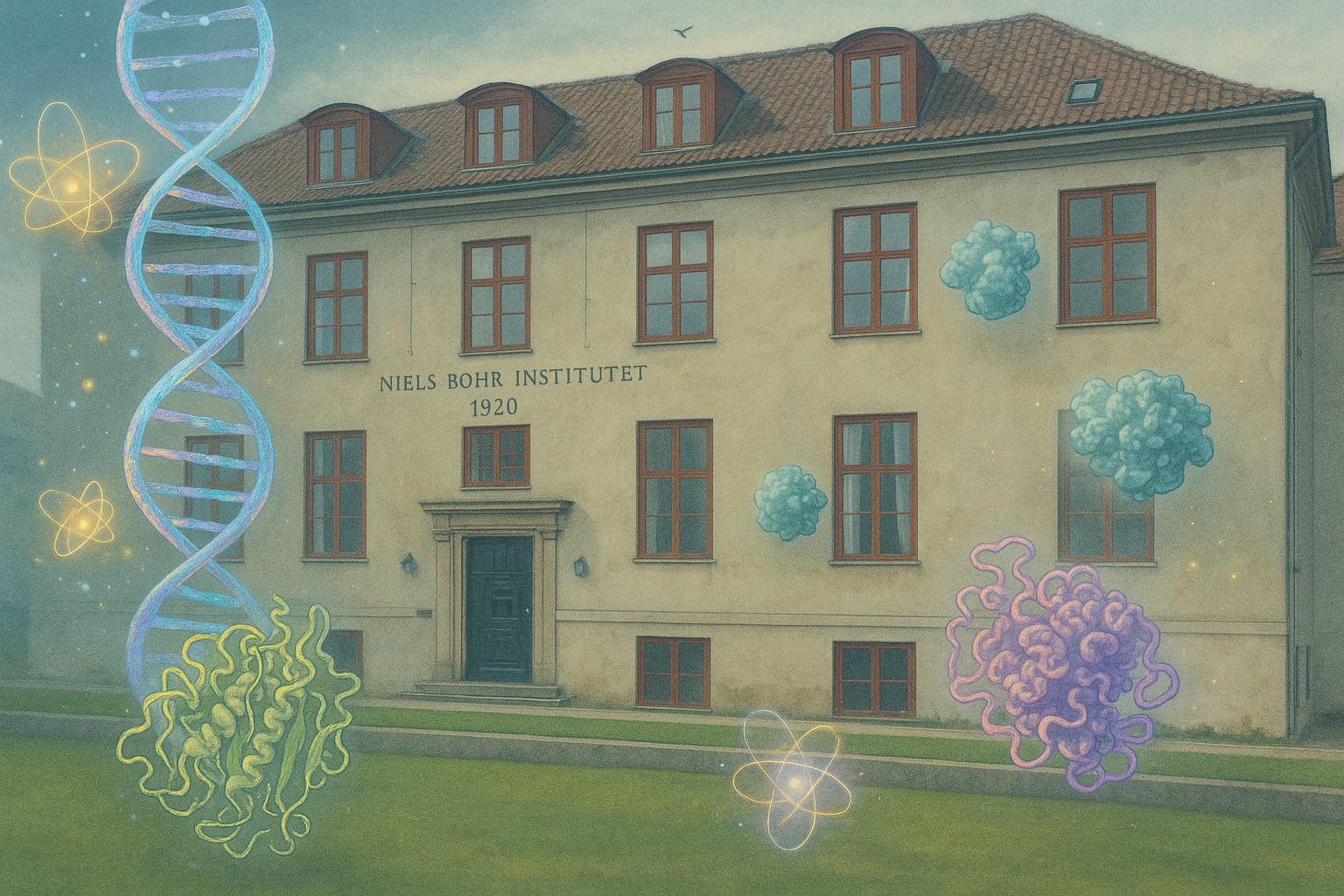
Frontiers and Challenges in Quantum Biology

Europe/Copenhagen
Auditorium A (Niels Bohr Institute)

Auditorium A

Niels Bohr Institute

Blegdamsvej 17 DK-2100 Copenhagen
Description


Frontiers and Challenges in Quantum Biology:

In 1932, Niels Bohr presented some speculative ideas concerning the application of quantum physics to living systems in a talk entitled “Light and Life” to the International Congress on Light Therapy being held in Copenhagen that year. Now, almost 100 years later this conference will bring together leading experts in the field of Quantum Biology in the place where he first postulated these ideas.


From the 16th to 17th April, we will host those interested in the application of ideas of quantum physics to biological systems at the Niels Bohr Institute in Copenhagen. This conference will comprise talks from keynote speakers who are world-leading experts in their fields, with plenty of opportunity for rigorous discussion and a poster session for students and early-career researchers.


We hope to welcome you to Copenhagen for what promises to be a fascinating event!


Confirmed speakers:

Ariel Furst (MIT)

Jim Al-Khalili (University of Surrey)

Nanna Holmgaard List (KTH Royal Institute of Technology and University of Birmingham)

Aurélia Chenu (Université du Luxembourg)

Luke Smith (University of Exeter)

Luca Gerhards (Carl von Ossietzky University Oldenburg)

Ilia Solov'yov (Carl von Ossietzky University Oldenburg)

Susannah Bourne-Worster (Durham University)

Adam Bradlaugh (Uni of Manchester)

Stefan Weber (University of Freiburg)

Alex Chin (CNRS)


Registration Process:

Due to limited seating capacity at the famous Auditorium A at the Niels Bohr Institute, participation is moderated. Registration requests will be reviewed manually, and confirmation of attendance will be sent once approval is granted. Registrations are only processed through this website.


Financial Support:

We are very grateful to our funders who have provided financial support towards this symposium: The Niels Bohr Institute Foundation, the Carlsberg Foundation and the European Society for Mathematical and Theoretical Biology (ESMTB).
Funders and Institution Logos


Welcome to Copenhagen:

The Niels Bohr Institute is in the centre of beautiful and vibrant Copenhagen, which offers a fantastic summer experience with its city life, music scene, and waterfront: Visit Copenhagen

Copenhagen also celebrates its title UNESCO-UIA World Capital of Architecture from 2023 to 2026 - see more here: World Capital of Architecture


NOTE: Please be aware of the usual scams sent out by companies pretending to arrange hotel accommodation for you. We do not cooperate with any companies, and you should not trust any emails about this event that do not originate from us.


Organisers: Mary Wood, Fabian Schuhmann, Weria Pezeshkian, Poul Damgaard


Registration
  • Thursday 16 April
    • 09:00
      Intro and Welcome
    • 1
      Quantum Effects in Radical Pair Dynamics and Biological Magnetoreception

      Life is governed not only by classical physics but also by quantum mechanics, especially in processes involving electron transitions. While all chemical reactions involve quantum phenomena, some biological systems appear to exploit them in surprising ways. A striking example is the ability of migratory birds to sense Earth’s magnetic field, plausibly via light-induced, spin-correlated radical pairs formed in retinal cryptochromes [1,2].
      In this talk, I will discuss how such radical pairs may act as a "chemical compass" [3]. I will outline the fundamental reaction steps in cryptochrome activation and deactivation, emphasizing how the interplay between protein structure, cofactors, and magnetic interactions possibly shapes spin dynamics and magnetic sensitivity of the protein [1,4,5]. Because proteins are dynamic, thermal motions modulate local interactions and drive spin relaxation, which can both degrade coherence and, under some conditions, tune sensitivity. Molecular dynamics simulations based on three-dimensional cryptochrome structures provide a way to examine these fluctuations and their consequences for radical-pair behavior [1,4–6].
      Theoretical approaches, including Redfield theory and stochastic Schrödinger dynamics, will also be discussed in the context of describing how environmental noise and molecular motion affect spin coherence in biological systems [7,8], alongside the use of modern computational platforms to implement such models efficiently [9]. I will close by highlighting broader implications for spin dynamics and possible quantum effects in biological chemistry beyond avian magnetoreception.

      References:
      [1] J. Xu, et al., Nature, 2021, 594, 535–540.
      [2] D. Timmer, A. Frederiksen, D. C. Lünemann, A. R. Thomas, J. Xu, R. Bartölke, J. Schmidt, T. Kubař, A. D. Sio, I. A. Solov’yov, et al., J. Am. Chem. Soc., 2023, 145, 11566–11578.
      [3] S. Y. Wong, A. Frederiksen, M. Hanić, et al., Neuroforum, 2021, 27 141–150.
      [4] F. Schuhmann, D. R. Kattnig, I. A. Solov’yov, J. Phys. Chem. B, 2021, 125, 9652–9659.
      [5] F. Schuhmann, et al., J. Phys. Chem. B, 2024, 128, 3844–3855.
      [6] G. Grüning, S. Y. Wong, L. Gerhards, et al., J. Am. Chem. Soc., 2022, 144, 22902–22914.
      [7] L. Gerhards, C. Nielsen, D. R. Kattnig, et al., J. Comp. Chem., 2023, 44, 1704–1714.
      [8] G. Jurgis Pažera, T.P. Fay, I.A. Solov’yov, et al., J. Chem. Theor. Comp. 2024, 20, 8412–8421 (2024).
      [9] V. Korol, P. Husen, E. Sjulstok, et al., ACS Omega, 2020, 5, 1254–1260.

      Speaker: Ilia A. Solov'yov
    • 10:30
      Coffee
    • 2
      The challenge of large systems: Exploring efficient computational methods for biochromophores

      One of the big challenges for computationally exploring quantum effects in biological systems is their sheer size. When accurately calculating quantum states, more atoms means more computational effort and this can very quickly get out of hand! In this talk I will discuss some strategies for evaluating the photoexcited states of biological chromophores at very low cost, highlighting the success (or not!) of these approaches, along with some example applications to photosynthetic systems.

      Speaker: Susannah Bourne-Worster
    • 3
      Adam Bradlaugh (title TBC)
    • 12:50
      Lunch
    • 4
      Controlling excited-state pathways in photoswitchable proteins

      Photoactive proteins provide natural systems in which biological function is governed by excited-state dynamics of embedded chromophores. This talk will discuss how protein environments control photochemical pathways that enable photoswitching, and how quantum-chemistry and nonadiabatic dynamics approaches help reveal the mechanisms underlying these processes.

      Speaker: Nanna Holmgaard List
    • 5
      Hyperpolarization and Magnetic Field Effects in Cryptochromes and LOV Domains: A Radical Pair Perspective

      The ability of living systems to sense and respond to weak magnetic fields has emerged as a compelling frontier in quantum biology. Blue-light photoreceptor proteins, particularly cryptochromes and LOV domain proteins, provide a unique platform in which light-driven function intersects with spin-dependent quantum dynamics. Upon photoexcitation, these systems generate spin-correlated radical pairs whose evolution is governed by the radical pair mechanism [1–4]. The coherent interconversion between singlet and triplet spin states renders reaction pathways sensitive to weak magnetic interactions, including fields on the order of the Earth’s magnetic field.
      In this lecture, it will be discussed how electron and nuclear spin dynamics in these radical pairs give rise to pronounced hyperpolarization effects under biologically relevant conditions [1–4]. Such non-equilibrium spin polarization, typically associated with magnetic resonance methodologies, emerges here intrinsically from the reaction dynamics and encodes information about the underlying spin Hamiltonian. Recent advances in detecting and quantifying these effects using state-of-the-art spectroscopic techniques, bridging concepts from electron spin resonance and nuclear magnetic resonance will be highlighted.
      Particular emphasis will be placed on the interplay between molecular structure, spin-selective recombination, and magnetic field effects in shaping observable hyperpolarization signals [4–8]. These findings provide new insight into how weak magnetic interactions can modulate biochemical outcomes through quantum-coherent spin evolution. By integrating experimental results with theoretical modeling, this work advances a unified picture of spin-dependent processes in photoreceptor proteins. It further positions radical pair systems in cryptochromes and LOV domains as model platforms for exploring the limits of quantum coherence in complex biological environments.

      [1] T. Biskup, E. Schleicher, A. Okafuji, G. Link, K. Hitomi, E.D. Getzoff, S. Weber, Angew. Chem. Int. Ed., 48 (2009) 404–407
      [2] S. Weber, T. Biskup, A. Okafuji, A.R. Marino, T. Berthold, G. Link, K. Hitomi, E.D. Getzoff, E. Schleicher, J.R. Norris, J. Phys. Chem. B, 114 (2010) 14745–14754
      [3] D. Nohr, S. Franz, R. Rodriguez, B. Paulus, L.-O. Essen, S. Weber, E. Schleicher, Biophys. J., 111 (2016) 301–311
      [4] G. Kothe, M. Lukaschek, G. Link, S. Kacprzak, B. Illarionov, M. Fischer, W. Eisenreich, A. Bacher, S. Weber, J. Phys. Chem. B, 118 (2014) 11622–11632
      [5] D. Nohr, B. Paulus, R. Rodrigues, A. Okafuji, R. Bittl, E. Schleicher, S. Weber, Angew. Chem. Int. Ed., 56 (2017) 8550–8554
      [6] T. Hochstoeger et al., Science Adv., 6 (2020) eabb9110
      [7] J. Xu et al., Nature, 594 (2021) 535–540
      [8] J. Gravell et al., J. Am. Chem. Soc., 147 (2025) 24286–24298

      Speaker: Stefan Weber
    • 16:00
      Short Coffee
    • 6
      As simple as possible, but not simpler: Environmental structure in quantum biology

      The complexity of biological environments is often assumed to act as a source of detrimental noise, destroying delicate quantum effects and potentially negating the need for quantum descriptions. However, their inherent structure may instead provide a resource that nature harnesses to steer quantum dynamics towards biological function. In this talk, I explore this idea by showing how realistic complexity is essential for scrutinising the predictions of idealised models and can reveal new mechanisms that enable functionality. Focusing on radical pair systems, which are proposed to act as quantum magnetosensors within the protein cryptochrome and hypothesised to underlie magnetoreception, I examine how environmental structure can influence and enhance magnetic field sensitivity and metrological performance. These results emphasise the importance of open quantum systems approaches that temper physical insight with sufficient realism and suggest how environmental structure may be harnessed by nature to steer biochemical processes and leveraged in engineered systems.

      Speaker: Luke Smith
    • 17:10
      Posters and refreshments
    • 19:00
      Speaker Dinner
    • 7
      Weak radiofrequency field effects in biological systems - A challenge for quantum biology

      The widespread use of radiofrequency (RF) communication has increased the exposure of organisms to electromagnetic fields, fueling debate about the potential biological effects of weak RF radiation. Experimental studies have suggested that low-amplitude RF fields may influence cellular metabolism, sleep patterns, or even cancer-related processes; however, these claims remain controversial, largely because the underlying physical mechanisms are unclear. A central concept in this discussion is the radical pair mechanism (RPM), a quantum-mechanical framework proposed to mediate magnetic and RF field effects in biology. Although the RPM has been invoked to explain magnetoreception and other magnetic-field-dependent chemical processes, it often struggles to account for observations at weak, non-thermal RF field strengths. In this talk, the applicability of the RPM to weak RF effects will be examined across different biological systems, highlighting both its potential and its limitations.

      Speaker: Luca Gerhards
    • 10:30
      Coffee
    • 8
      From the ultrafast dynamics of photosynthesis to the quantum design of energy harvesting materials

      In 2008, the unexpected observation of coherent excitonic dynamics in photosynthetic proteins kick-started a vibrant interdisciplinary effort to explore the possible roles and advantages of non-classical effects in biological processes. Today, claims that Nature actually exploits quantum mechanics in vivo remain highly controversial, but a key outcome of 'Quantum Biology' has been to expose the exquisite nano engineering of light-harvesting proteins to powerful theoretical and computational tools from across condensed matter, quantum information and chemical sciences. From these techniques, a deep, microscopic understanding has arisen of how (open) quantum dynamics can drive sophisticated optoelectronic functionalities in protein structures, inspiring light-harvesting concepts that could be realized in artificial nanotechnologies. In this talk I will present an overview of our work on biological light-harvesting, covering the highly tuned electronic structure of pigment-protein complexes, the critical role of structural vibrations in ultrafast energy transport, and how these could be leveraged for quantum-enhanced energy harvesting in man-made systems. Time permitting, I will also present some of the 'bio-inspired' devices in which these ideas have actually been tested, including organic photovoltaics, DNA origami and, even, superconducting qubit circuits.

      Speaker: Alex Chin
    • 9
      Ariel Furst (Title TBC)
    • 12:50
      Lunch
    • 10
      Generalizing Förster resonance energy transfer to allow for transient coherent effects

      The traditional Förster theory applies in the limit where the intermolecular coupling is weak, and the system-bath coupling is strong. We use an approximation for the bath to generalize the traditional Förster master equation for the state population probabilities into a complete master equation for the system's reduced statistical operator. The bath ansatz comes from a zero-th order perturbation in the system-system coupling. It allows us to formulate the weak intramolecular coupling Förster resonance energy transfer theory in a form suitable for calculating ultrafast nonlinear response of molecular systems.

      The theory predicts a rapid initial coherent evolution of populations arising from a transient initial coherence-dependent term, which induces a slippage of the initial condition that persists during subsequent rate-controlled transfer. Comparison with exact numerical results (HEOM) confirms the clear improvement of the present generalization over earlier formulations of the Förster theory and delineates its range of validity.

      Reference:
      Förster resonance energy transfer with transient coherent effects, Maximilian Meyer-Mölleringhof, Pablo Martinez-Azcona, Aurélia Chenu, Tomáš Mančal, https://arxiv.org/abs/2602.17789

      Speaker: Aurélia Chenu
    • 11
      Did life evolve to make use of quantum mechanics?

      In this talk, I will first briefly trace the history of quantum biology back to its origins almost a century ago and the influence of Niels Bohr (as seems appropriate at this meeting's venue) and highlight some of the key landmarks along its sometimes controversial past, up to it emergence in the 21st century as one of the most exciting areas of interdisciplinary research. I will then focus on recent work at Surrey with a focus on my own interests in the quantum tunnelling of H-bond protons between DNA nucleotide bases and their role in point mutations. The work is a synthesis of computational chemistry via density functional theory and an open quantum systems approach to model molecular processes in the cell. I will end with a challenge to the community to answer the fundamental question, first laid out by Schrödinger in his book What Is Life? of whether life not only knows about quantum mechanics, but has evolved the ability to utilise its tricks in order to have, or prevent it from having, a functional role in biology that is distinct from the role of quantum mechanics in inanimate matter of equivalent complexity.

      Speaker: Jim Al-Khalili
    • 16:00
      Drinks reception