Conference information
Extra information
Goal
The workshop will take place at the Max Planck Institute for Astronomy in Heidelberg on November 9 - 13, 2026. This will be the second meeting in the series, following the “NBIA Radiative Transfer in Astrophysics” workshop held at the Niels Bohr International Academy in June 2022.
NEWS
We're particularly excited and proud to announce that the Gruber Cosmology Award 2026 Ceremony will take place during the workshop. Alexei V. Filippenko, Ken'ichi Nomoto, and Stanford Woosley will receive the award for “transforming supernovae from poorly understood stellar explosions into the basis for a quantitative, predictive, and empirically validated framework.”, and the award ceremony will take place on November 10 at HdA.
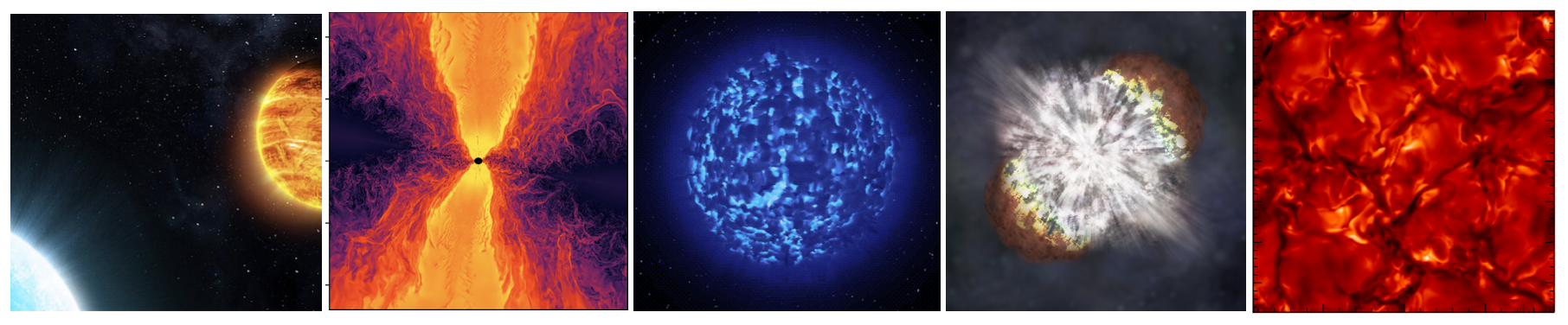
As with its predecessor, the RT II meeting is designed to be highly interdisciplinary, with a focus on non-LTE and non-equilibrium radiative transfer, as well as 3D radiation hydrodynamics. We will address a wide range of astrophysical environments, including atmospheres of low-mass and massive stars, exoplanetary atmospheres, black hole accretion disks, tidal disruption events, kilonovae, and supernovae.
This year, in light of the rapidly increasing quality and quantity of observational data (e.g., Galactic spectroscopic surveys, Gaia, LSST, JWST, among others), we would like to place particular emphasis on the application of these methods to pressing astrophysical problems. We aim to explore how 3D NLTE models can provide a fresh and innovative perspective on astrophysical diagnostics and chemical composition of these objects, paving the way to the exploitation of ground-based extremely large telescopes and next-generation space facilities, like Nancy Grace Roman, Habitable Worlds Observatory, and ULTRASAT.
Workshop Topics
- Stellar Atmospheres
- Exoplanetary Atmospheres
- Accretion Discs
- Tidal Disruption Events
- Supernovae
- Kilonovae
Registration and Abstract Submission
Registration and abstract submission are now open; both will close in August 1, 2026.
Venue and Organizational Aspects
The workshop will take place at the Max Planck Institute for Astronomy in Heidelberg, Germany. The lectures will take place in the House of Astronomy (https://www.haus-der-astronomie.de/en) next to MPIA. MPIA will provide infrastructure in the form of discussion rooms to facilitate collaborations and discussions in smaller groups. A social dinner for all participants will be organized during the workshop.
There will be no registration fee to attend the meeting.
SOC
- Maria Bergemann (MPIA), Chair
- Melina Bersten (La Plata University)
- Shane Davis (University of Virginia)
- Luca Fossati (Space Research Institute Graz)
- Anders Jerkstrand (Stockholm University), Co-Chair
- Martin Pessah (NBIA), Co-Chair
- Jon Sundqvist (KU Leuven)
LOC
- Christelle Hiemstra
- Maria Bergemann
Invited Speakers
- Andrew Chael
- Christine Collins
- Jane Dai
- Lara Delbroek
- Antonio Garcia Munoz
- Kenta Hotokezaka
- Daria Kubyshkina
- Brenna Mockler
- James Stone
- Nicholas Storm
This program is supported by

Figure credits (left to right):
Austrian Academy of Sciences; Chris White; Lara Delbroek; NASA/CXC/M.Weiss; Philipp Eitner/Maria Bergemann